

In this application, a function-critical internal bore in high-strength, corrosion-resistant stainless steel is finish-machined directly on a CNC machining centre. The nominal diameter is Ø67.75 mm H8.
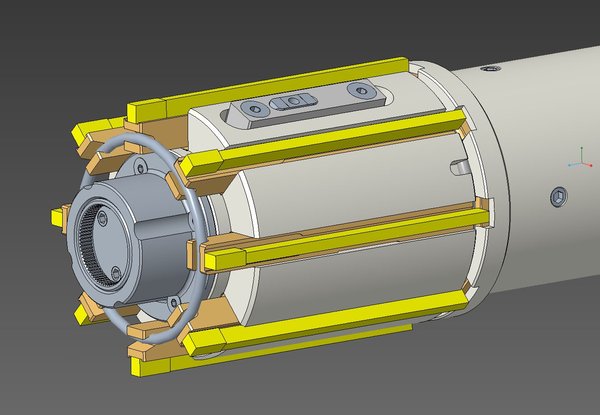
A DIAHON coolEXact multi-stone honing tool with integrated EXact size compensation and µ-matik interface is used. The objective of the honing process is a repeatable functional surface of Ra < 0.4 µm and Rt <= 4 µm without transferring the component to a separate honing machine.
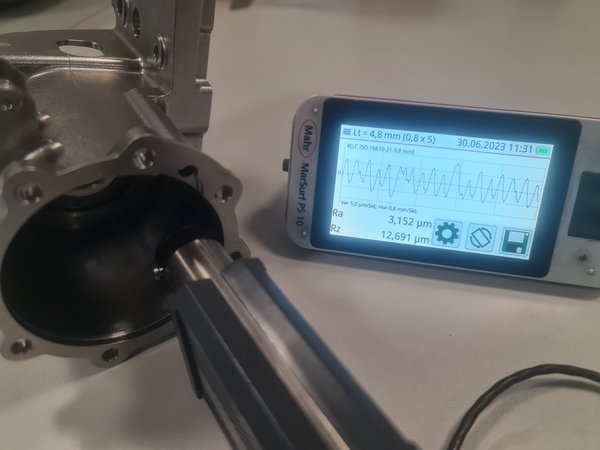
Initial condition: The documented pre-machining showed a locally much rougher surface than permitted for the functional requirement. Individual measurements were Ra = 3.152-3.592 µm and Rz = 12.691-14.852 µm.
Two-stage process design: Because of the initial roughness, the honing process was designed as a two-stage process. The honing stages reduce roughness in a controlled manner while moving the bore toward the required final size.
coolEXact honing: The DIAHON coolEXact multi-stone honing tool performs defined stock removal and repeatable size correction directly on the machining centre.
µ-matik size compensation: The µ-matik interface enables defined tool adjustment. This allows wear to be compensated and the final size to be stabilised across production.
Coolant supply: Stable coolant supply is essential for reliable coolEXact tool operation. A pressure range of approximately 10-25 bar is specified for this application.
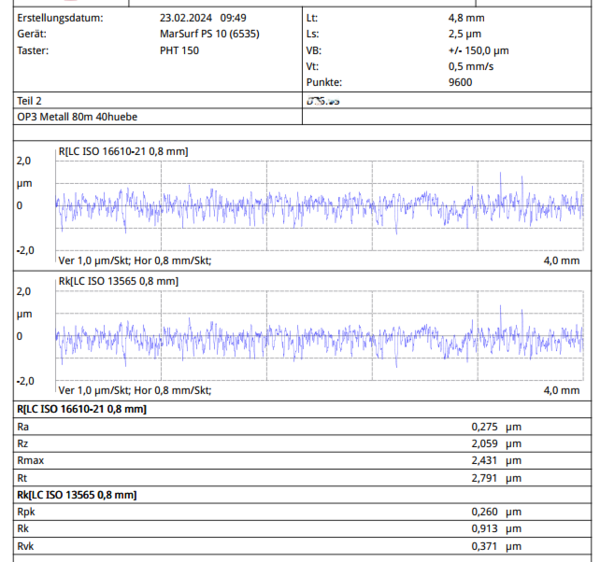
One selected, documented condition after honing shows:
Series evaluation also documented values around Ra = 0.32 µm and Rt = 3.45-3.9 µm. The functional targets of Ra < 0.4 µm and Rt <= 4 µm are therefore achieved.
Can an H8 bore be honed directly on a machining centre?
Yes. With a suitably designed DIAHON coolEXact tool, size and surface corrections can be performed directly on a CNC machining centre.
How is tool wear compensated?
EXact size compensation enables defined adjustment. Via the µ-matik interface, this correction can be integrated repeatably into the production process.
What surface finish was achieved?
A selected measurement after honing showed Ra = 0.275 µm, Rz = 2.059 µm and Rt = 2.791 µm. Series values were around Ra = 0.32 µm.
DIAHON coolEXact enabled precision honing of the Ø67.75 mm H8 bore directly on a CNC machining centre. The process combines controlled stock removal, repeatable size compensation and a functional surface finish. One selected measured condition achieved Ra = 0.275 µm and Rt = 2.791 µm, while the documented series values also meet the target requirements.